
Introduction: The Silent Dialogue Between Art and Space
At Prime Vista Art, we understand that every piece of art carries a unique story. When integrated into a space, it initiates a new spatial narrative. Selecting the perfect artwork is not merely about taste and style; it is an art of scale, proportion, and harmony. Especially when confronted with the grandeur and minimalism of modern architecture, the challenge for every collector and design enthusiast is to ensure the artwork complements, rather than clashes with, the architectural scale. Today, we will delve into how to choose artworks that best tell a story, considering the architectural dimensions of your space.
1. The Wall: Art’s Stage – The ‘Golden Ratio’ Principle
A blank wall serves as the purest stage for art. But how does one determine the optimal size for artwork on this stage? Our aim is not to adhere rigidly to formulas, but to understand the aesthetic principles behind them. A universally accepted ‘golden ratio’ principle can help you quickly pinpoint the ideal range.
This range ensures the artwork has sufficient visual presence without making the space feel overcrowded. To understand more about the aesthetic dimensions of minimalist pieces, check out our guide on 5 Key Dimensions for Evaluating Minimalist Abstract Art.
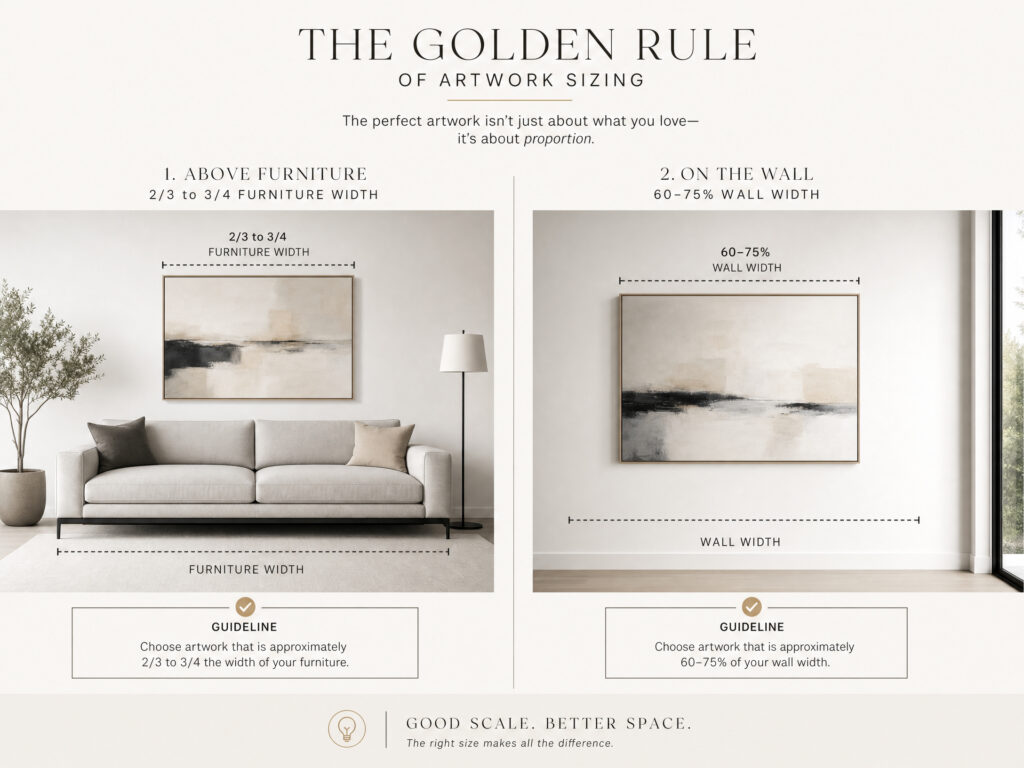
Rule of Thumb: 60% – 75% of Wall Width
When hanging a single piece of art on an empty wall, remember this guideline: the artwork’s width should occupy 60% to 75% of the wall’s width. According to professional art consultants, maintaining this ratio is key to visual balance. For instance, if your wall is 100 inches (approximately 254 cm) wide, the ideal artwork width would be between 60 and 75 inches (approximately 152 to 190 cm).
2. Furniture: Art’s Companion – The ‘Harmonious Coexistence’ Principle
Artwork often forms a visual focal point in conjunction with furniture, such as above a sofa, a bed, or a console table in an entryway. In such cases, the artwork’s size selection must consider its harmonious coexistence with the furniture below.
Rule of Thumb: 2/3 to 3/4 of Furniture Width
When artwork is hung above a sofa, bed, or other furniture, its width should be 2/3 to 3/4 of the furniture’s width. For example, for an 84-inch (approximately 213 cm) wide sofa, the artwork above it should be between 56 and 63 inches (approximately 142 to 160 cm) wide. This proportion creates a sense of visual balance and stability, allowing the artwork and furniture to form an organic whole.
Hanging Height: The Visual Comfort Zone
Beyond width, hanging height is also crucial. A common gallery standard is for the center of the artwork to be 58 inches (approximately 147 cm) from the floor. This standard gallery height ensures a comfortable viewing experience for all visitors. This is typically a comfortable eye-level height.
3. Architecture: Art’s Context – The ‘Dialogue with Space’ Principle
Modern architecture often features high ceilings, expansive walls, and unique structures. In this context, artwork is no longer merely decorative; it becomes a medium for deep dialogue with the architecture.
High Ceilings: The Stage for Monumental Art
In spaces with high ceilings or double-height voids, a monumental artwork can instantly elevate the grandeur and artistic tension of the space. It not only fills visual emptiness but also becomes the soul of the entire area, guiding the eye upwards and emphasizing the architectural verticality.
Minimalist Architecture: Negative Space and Focal Points
In minimalist architecture, negative space itself is an art form. Here, the selection of artwork should prioritize the purity of its form, material, and color. This sense of purity is also reflected in the latest 2026 Soulful Minimalism Color Trends, where space and color engage in a subtle dialogue. A carefully chosen, appropriately sized artwork can become the sole visual focal point in the space.
Conclusion: Curating is Composing a Story for Space
Ultimately, choosing artwork size is about better composing a story for space. It concerns the emotions you wish the space to convey, and how art and architecture can mutually enhance each other. From walls to furniture, and to the overall architectural scale, every choice is a deliberate act of curation.
At Prime Vista Art, we believe that when artwork is integrated into a space with the most appropriate size, it ceases to be an isolated entity. Instead, it becomes an indispensable chapter in the spatial narrative, breathing and growing alongside its inhabitants.