

A Collector’s Guide to Evaluating Artwork, Sellers, and the Details That Matter
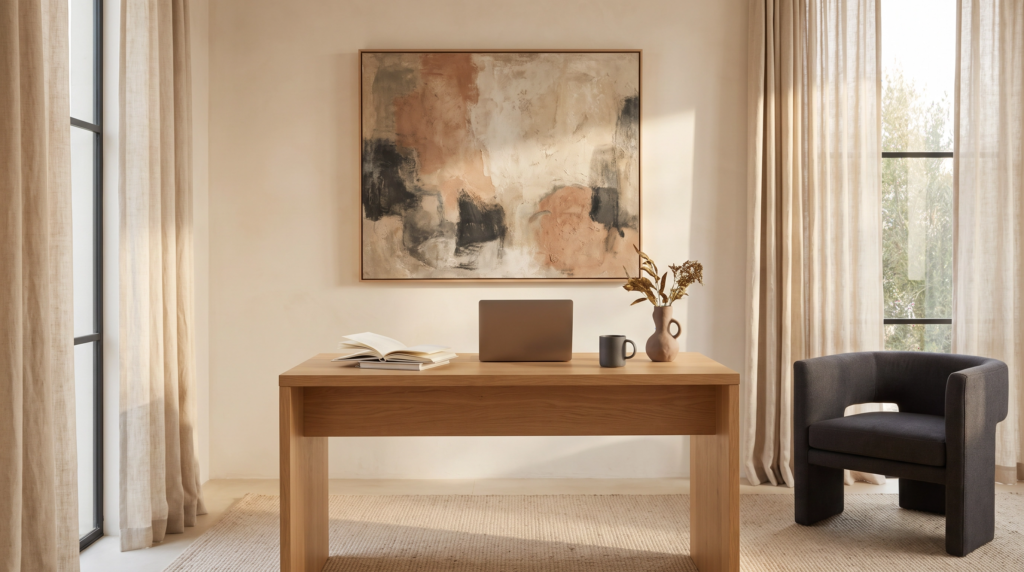
Buying art online can feel strangely intimate. You may encounter a work alone, late at night, through a screen that reduces its scale and removes the physical presence of its surface. Yet the response can still be immediate. A color holds your attention. A composition reminds you of a place. A quiet image begins to feel as though it belongs somewhere in your life.
That first response matters, but it should not be the only thing guiding a purchase. Learning how to buy art online begins with giving your first response enough time, then testing that response against clear and reliable information. Online collecting requires two forms of attention at once: the emotional attention that tells you why a work matters, and the practical attention that helps you understand exactly what you are buying. Learning how to buy art online begins with separating genuine interest from the excitement of presentation.
Learning how to buy art online with confidence does not mean removing uncertainty from the process. It means knowing which questions to ask before enthusiasm becomes commitment. You need to understand the artwork, the seller, the transaction, the delivery conditions, and the place the work may eventually occupy in your home.
A confident online art purchase is not made without questions. It is made after the important questions have been answered clearly.
This guide is designed for first-time buyers and thoughtful collectors who want to browse online without treating every purchase as an emergency. It does not recommend one platform or guarantee a particular result. Instead, it offers a careful method for moving from attraction to informed decision.
1. Begin with the Artwork, Then Verify the Listing
The first step is still personal. Before you study the seller, the price, or the social proof around a work, give yourself a moment to look. What holds your attention? Is it the color, the structure, the texture, the scale, or the emotional atmosphere? Would you want to return to the image if there were no price attached to it and nobody else knew you had seen it?
Online, this first response is often shaped by presentation. A carefully photographed artwork may feel more compelling than a poorly documented one, even when the underlying work is not necessarily stronger. Try to separate the work from the styling around it. Look at the artwork itself, then look again at the available detail images.
Pay attention to whether the listing shows more than one view. A reliable presentation may include the full front of the work, a close view of the surface, the edges, the reverse if relevant, and an installation or scale reference. These views do not replace seeing the work in person, but they help you move beyond a single flattering image. This distinction is central to how to buy art online without allowing a beautiful photograph to make the entire decision for you.
Ask yourself three initial questions:
1.What exactly is attracting me?
2.What information do I still need before I can judge the work fairly?
3.Would my interest remain if the work were shown without decorative furniture or dramatic lighting?
A strong emotional response is a reason to investigate further, not a reason to skip investigation.
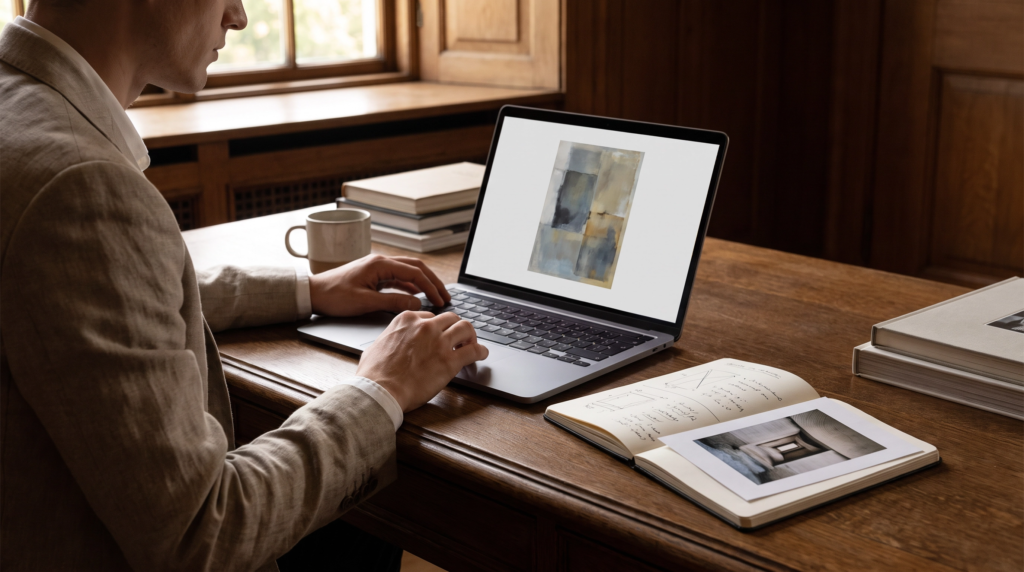
Caption: Online browsing should begin with attention, but confidence develops through verification.
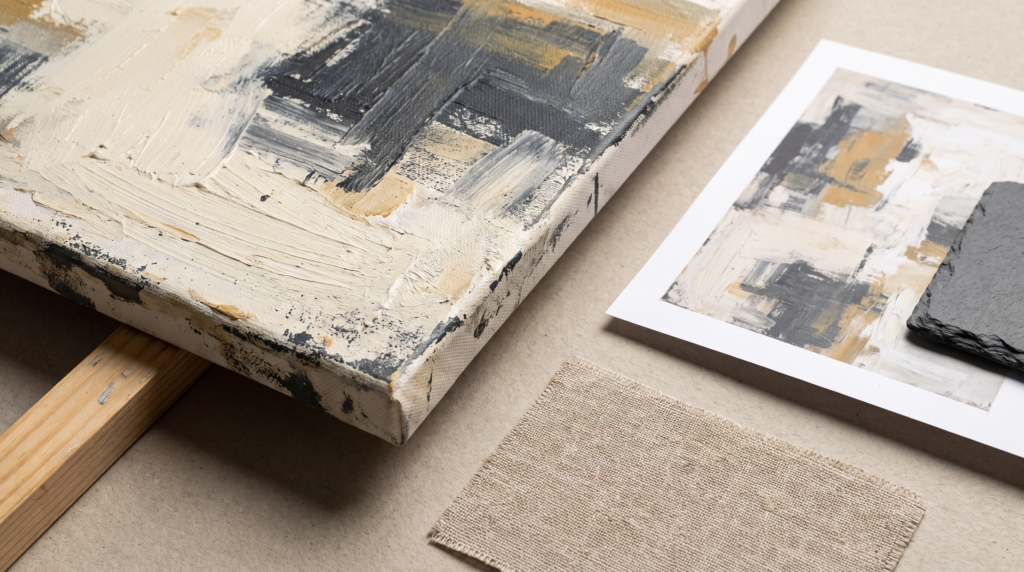
Caption: Detail images help reveal what a single front-facing photograph cannot show.
2. Read the Artwork Listing Like a Curator
A beautiful photograph can introduce a work, but the listing should explain it. Before you become attached to a piece, locate the practical information that defines the object.
Start with the artist’s name, the title, the year, the medium, and the dimensions. Check whether the listed dimensions describe the artwork alone or the artwork including its frame. This distinction matters when you are planning a wall, comparing a piece with furniture, or estimating shipping requirements.
The medium also deserves careful attention. “Mixed media” can describe many different processes, from layered paper and pigment to objects incorporating fabric, metal, wax, or found material. If the description is broad, ask for clarification. The more unusual the material, the more important it is to understand how the work should be handled and displayed.
For editions, confirm the edition size and the number of the individual work where applicable. For photography and prints, look for information about the printing process, paper, inks, and whether the work is signed or accompanied by a certificate. These details do not determine whether you will love the work, but they determine what the object is.
If the listing uses vague language where precise information should be available, slow down. A missing detail is not automatically a warning sign, but it is a reason to ask a direct question before purchasing. This is how to buy art online with curiosity while still protecting your judgment.

Caption: The listing is part of the artwork’s practical identity; read it before you fall in love with the image alone.
3. Evaluate the Seller and the Source of the Work
Online art buying involves a relationship, even when the transaction takes place through a marketplace. To learn how to buy art online responsibly, you must evaluate the source of the work as carefully as the work itself. You are not only evaluating the work. You are also evaluating the person, gallery, platform, or organization presenting it. To learn how to buy art online responsibly, you must evaluate the source of the work as carefully as the work itself.
Look for a clear seller identity and a consistent body of information. Does the seller provide a professional biography, contact method, location, and explanation of how works are shipped? If a gallery represents the artist, is the relationship explained? If the platform hosts independent sellers, does it describe its role in the transaction?
Consistency matters. The artist’s name should appear the same way across the listing, certificate information, and any supporting materials. The medium and dimensions should not change between the main page, the shipping section, and the checkout summary. Small inconsistencies may be innocent errors, but they should be resolved before payment.
You should also understand who is responsible for the sale. In some online marketplaces, the platform processes the order while the artist or gallery fulfills it. In other arrangements, the platform is only an intermediary. This affects whom you contact about condition, shipping, returns, and documentation.
Reviews can provide context, but they should not replace evidence. A large number of positive comments does not confirm that a particular work is authentic, well packed, or accurately described. Treat reviews as one part of the picture.
If the seller avoids reasonable questions, pressures you to pay outside the platform, or provides contradictory answers, pause the purchase. A work that requires you to ignore basic uncertainty is not a low-risk purchase simply because it is visually appealing.

Caption: Trust grows when the artist, seller, artwork, and transaction details tell the same story.
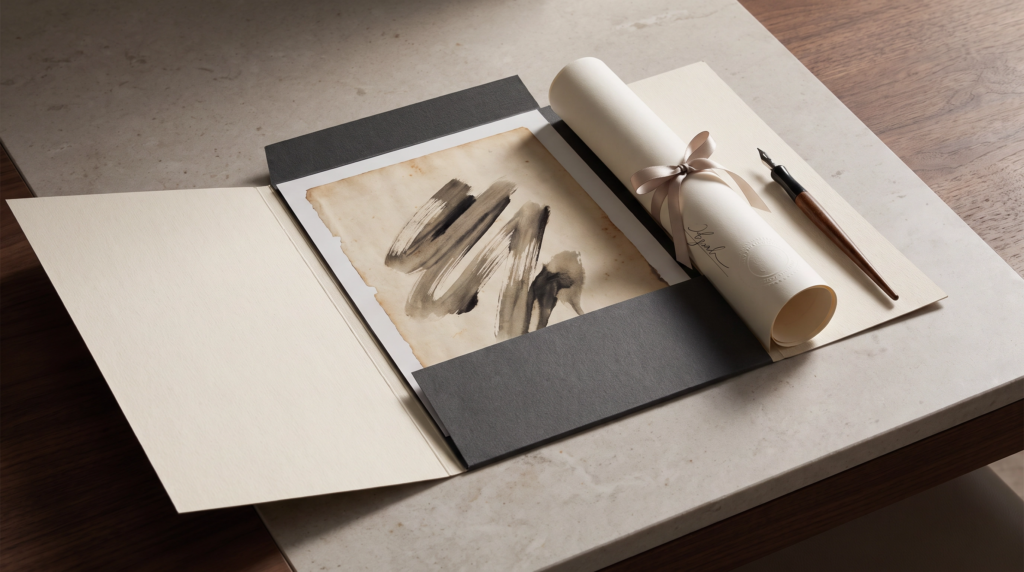
Caption: Documentation does not replace your emotional response, but it supports a responsible decision.
4. Judge Scale, Color, and Context Before You Buy
A digital image can make a small work feel monumental and a large work feel manageable. Screen brightness can intensify color. Room staging can make an artwork appear more neutral, warmer, or more dramatic than it may feel in your own space.
Before purchasing, place the dimensions into your room. Use painter’s tape or paper to mark the approximate width and height on the wall. Stand at the distance from which you will usually see the work. Consider the height of nearby furniture, the direction of natural light, and whether the artwork will be viewed from a sofa, a dining table, a hallway, or a bed.
Do not assume that a work shown in a beautiful interior will create the same effect in yours. The surrounding architecture, wall color, floor material, and lighting all influence perception. If you want more guidance on the relationship between artwork and interior space, read How Can One Painting Transform a Room? A Practical Guide to Displaying Minimalist Art.
Color requires the same caution. Ask whether the listing includes daylight images as well as styled images. If the work uses subtle neutrals, request a photograph taken in natural light. If the surface is glossy, ask how reflections affect visibility. If the work is highly textured, look for a close-up rather than relying on a compressed screen image.
A careful online buyer does not ask only, “Do I like this image?” The better question is, “How might this object behave in the conditions where I will live with it?”
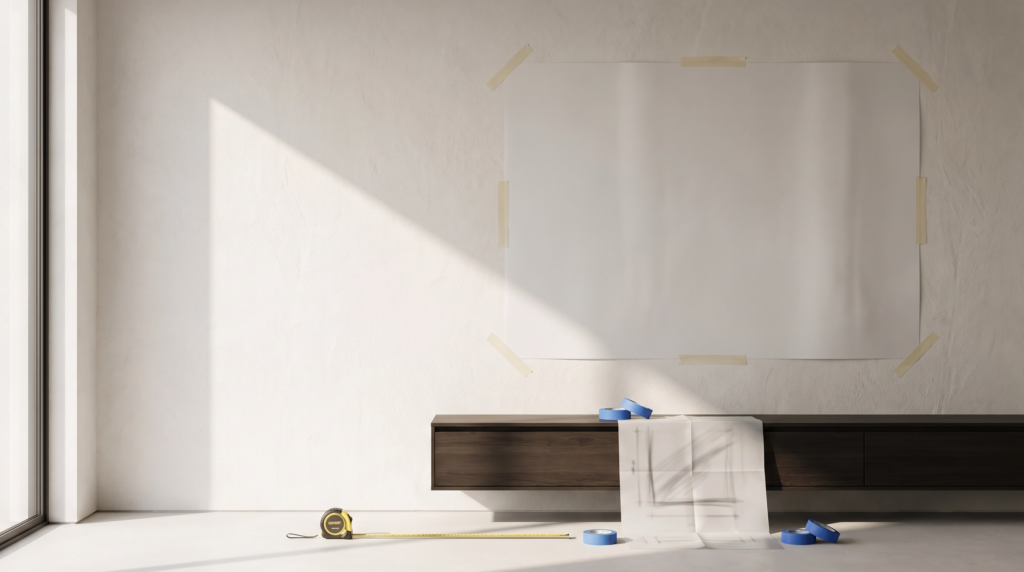
Caption: Testing the dimensions on your own wall can prevent an attractive online image from becoming a physical mismatch.
5. Ask the Questions That Photographs Cannot Answer
A listing may answer many questions, but not all of them. Before you buy, prepare a short list of direct questions. A professional seller should be able to answer clearly or tell you what information is unavailable.
Ask about the artwork’s current condition. Is there any visible damage, restoration, discoloration, warping, or surface change? If the work is framed, is the frame included in the price? Is the frame archival, original to the work, or simply a presentation frame? If the work is unframed, are there recommendations for handling or display?
Ask how the artwork will be packed. A small paper work may require different protection from a large stretched canvas or a fragile object. Ask whether the shipment will be insured, whether tracking will be provided, and whether a signature will be required at delivery.
You should also ask about timing and returns. Is the work ready to ship, or will it be made to order? How long does preparation usually take? What happens if the work arrives damaged? Under what conditions can it be returned, and who is responsible for return shipping?
Keep the answers in writing. This is not distrustful behavior. It is a way to prevent two people from remembering the same transaction differently.

Caption: The questions that feel too practical before purchase often become the most important after delivery.
6. Understand Payment, Shipping, and Return Conditions
The price of an artwork is only one part of the financial decision. Before checkout, identify the total cost and the terms attached to it.
Check whether the displayed price includes the frame, taxes, customs charges, shipping, insurance, and handling fees. International purchases may involve costs that do not appear until later in the process. If the final total is unclear, ask for a written estimate before paying.
Use the platform’s official payment process whenever possible. For general guidance on safer online shopping and payment practices, consult the Federal Trade Commission’s Online Shopping advice. Be cautious if a seller asks you to move payment to an unrelated account, use an unfamiliar link, or bypass the platform’s protections. Be cautious if a seller asks you to move payment to an unrelated account, use an unfamiliar link, or bypass the platform’s protections. A request to pay outside the established process may expose you to unnecessary risk.
Read the return policy carefully. Some works are final sale. Others may be returned only within a limited period or only if they remain in their original packaging. A return policy may also distinguish between damage in transit, a work that differs materially from its listing, and a simple change of mind.
Save the listing, the order confirmation, the correspondence, and the shipping documentation. These records are useful if you need to resolve a problem and helpful for your own collection archive. Keeping them is an essential part of how to buy art online with confidence. These simple records are an essential part of how to buy art online with confidence. These records are useful if you need to resolve a problem and helpful for your own collection archive. These simple records are an essential part of how to buy art online with confidence.

Caption: A secure purchase includes clarity about the total cost, payment process, delivery, and recourse if something goes wrong.
7. Make the Decision Without Artificial Urgency
The final decision should contain both feeling and patience. You may be deeply drawn to a work and still need time to check its dimensions, condition, seller information, and delivery terms.
Urgency can be legitimate. A unique original may sell, and a limited edition may have a defined number of available works. But urgency is not the same as pressure. If the seller uses countdowns, repeated warnings, or emotional language to prevent reasonable questions, step back and assess the situation.
Set a personal pause before purchasing. For a modestly priced print, that pause may be a few hours. For an original work or a substantial purchase, it may be several days. During that time, look at the work in a different browser or on a different screen. Read the details again without the excitement of the first encounter. Imagine the work after the novelty has passed.
Ask yourself:
•Would I still want this work if it were not currently discounted?
•Can I explain what attracts me without repeating the seller’s language?
•Do I understand what I am buying?
•Is the total cost comfortable rather than merely possible?
•Am I choosing the work, or reacting to the fear of losing it?
If the answer is not yet clear, waiting is not failure. It is part of learning how to buy art online with confidence. A measured pause is one of the simplest ways to make how to buy art online a more thoughtful process.

Caption: A deliberate pause protects genuine conviction from the temporary intensity of online browsing.
Conclusion: Let Confidence Come from Clarity
The best online art purchases do not begin with a perfectly designed website or a persuasive caption. In practice, how to buy art online is less about speed than about clarity. They begin with a work that continues to hold your attention, followed by a process that respects your questions.
Look carefully at the artwork. Read the listing. Evaluate the seller. Test the scale in your own space. Ask about condition, framing, shipping, payment, and returns. Keep the relevant records. Most importantly, do not allow a digital interface to create a false sense of urgency.
Buying art online can never reproduce every quality of seeing a work in person. It can, however, become a thoughtful and responsible way to collect when emotional response is supported by practical clarity. The goal is not to eliminate every unknown. It is to know which unknowns matter, which questions can be answered, and when you have enough information to make a decision that feels like your own.
For more guidance on the emotional role art can play in daily life, explore Art as an Emotional Sanctuary. For practical guidance on presenting a work after it arrives, read Art Lighting for Collectors.