

A Beginner’s Guide to Building a Personal Collection
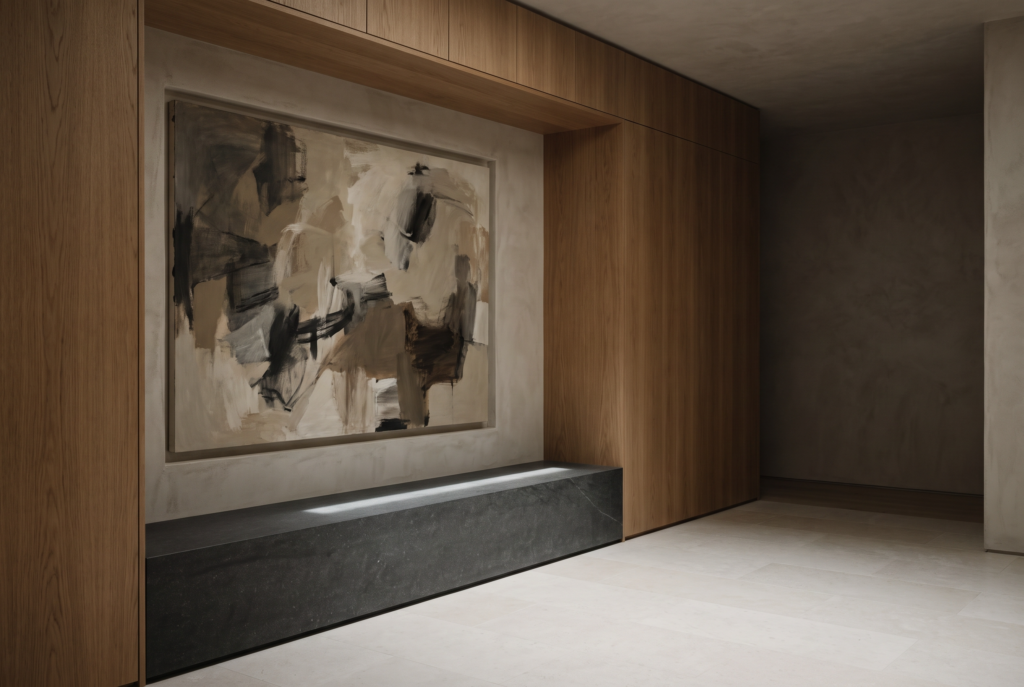
There is a moment that almost every collector remembers. You are standing in a quiet room — a gallery, a friend’s house, a studio — and one work stops you. Not because of its name or its price, but because something inside you answers before you can explain it. Perhaps it is the color. Perhaps it is the silence around a single form, or a texture that recalls a place you once lived. You look away, and then you look back. The feeling does not leave.
A personal collection does not begin with the most expensive artwork. It begins with the work you continue to think about.
Choosing art is not an art-history examination. You do not need the right vocabulary, the right names, or the right decade to trust what you see. What lasts is more ordinary and more durable: honest responses, repeated looking, and a quiet sense of connection to the life you actually live.
This guide is about how to choose art that feels like you. It walks through the way real choices happen — noticing your first response, reading your own taste, weighing space and budget, and understanding what you are actually buying. No shortcuts, no pressure, and nothing to prove. Learning how to choose art begins with understanding your own response before considering outside opinions.
1. Start with Your Response, Not the Artist’s Reputation
Most of us have been trained to ask who made a work before asking how it makes us feel. Reputation, market standing, and price arrive before the artwork itself, and they are heavy. They can make an ordinary piece feel important and a quiet one feel negligible. If you are a first-time buyer, this is the first habit worth unlearning.
Start instead with your response. When you stand before a work, hold the artist’s biography and the price tag at a comfortable distance, and let your body answer first. You might feel calm, tension, recognition, curiosity, or even resistance — and resistance is information too. Notice the color, the texture, the scale, the gesture of the brush or the hand, the negative space around the form, and the memories that surface without your permission. None of these is a test you can pass or fail. They are simply data about the relationship forming between you and the work.
One viewing is rarely enough. The most useful habit is to leave, live for a while, and come back. Works that merely impress tend to fade within days; works that matter keep finding their way back into your attention. If a piece still holds you on the second or third visit — with no one else in the room, no context to lean on — that is a stronger signal than any signature.
What to Notice During a First Look
When you return for a second look, these questions can steady you:
- Which part of the work do my eyes keep returning to?
- Does the work feel calmer, busier, more open, or more charged the longer I stay with it?
- What place or memory does it call up without my trying?
- If I had to describe it to a friend tomorrow, what would I remember?
Answer them slowly. There is no rush to decide in the first five minutes. This slower approach is one of the most reliable foundations for learning how to choose art with confidence.
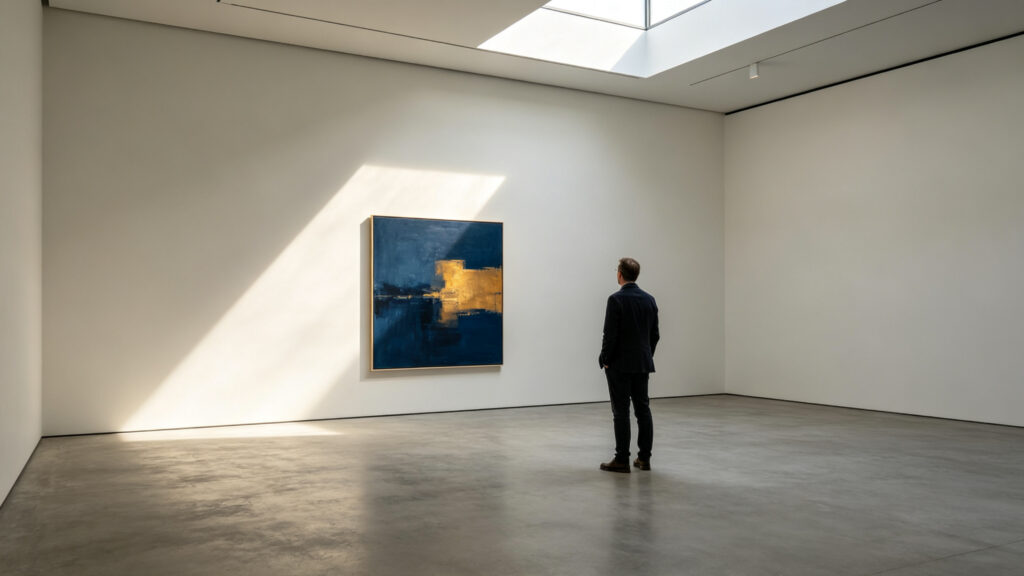
Caption: The first response to an artwork can be the beginning of a lasting relationship.
2. Notice the Patterns in What You Already Love
You may believe you do not know what you like. In fact, you have been curating all your life. When you are learning how to choose art, your existing visual habits are often a more useful starting point than a list of fashionable styles. The colors you choose for your clothes, the ceramics on your shelves, the books you keep on the coffee table, the photographs you save from trips, the buildings and landscapes you slow down to look at — all of it is a record of your visual preferences, written without your noticing.
Read that record as evidence. Notice whether your taste runs toward soft color transitions or strong contrast, organic forms or geometric structure, the visible hand of the maker or a clean industrial finish. You might discover that almost everything you own shares one quiet palette, or that you are drawn to exactly one vivid accent in an otherwise neutral room. This is not about forcing yourself into a named style. It is simply observation — the same skill you will bring to a gallery.
If you find yourself circling a particular color or mood, go deeper with Minimalist Color Psychology: How Color Shapes Emotional Balance, a closer look at how hue shapes the emotional temperature of a space.
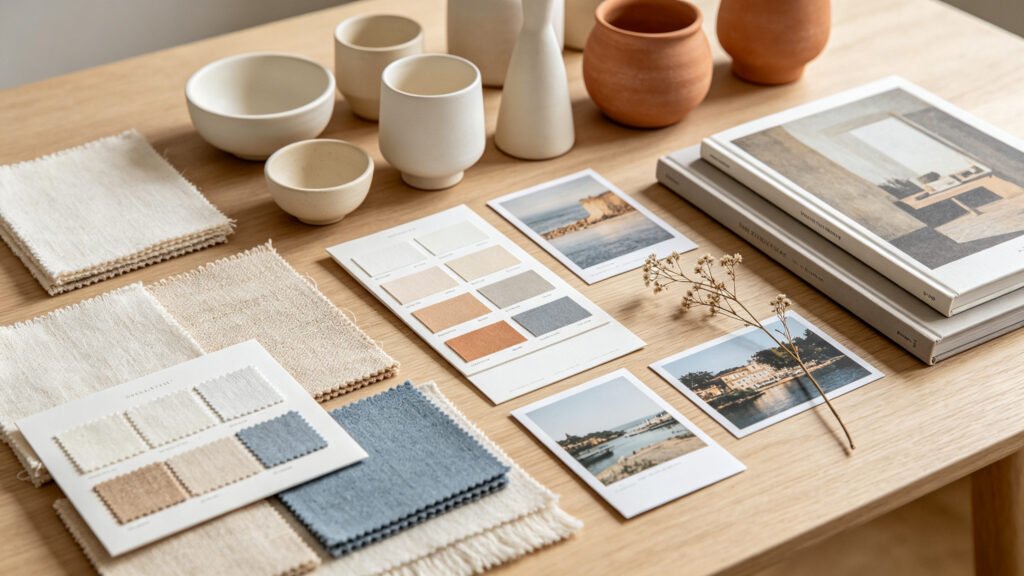
Caption: Personal taste often becomes visible in the colors and materials already present in daily life.
3. Choose Meaning Before Matching
The sofa is linen. The walls are warm white. The artwork goes beautifully — which is precisely the problem. A work bought only because it matches the room is interchangeable: swap in another piece in the same palette and nothing changes. Matching is a service to the decor. Meaning is a service to you.
There is a difference between harmony and sameness. A work can harmonize with a room through contrast — through emotional depth, warmth, quietness, or even a productive tension that gives both the room and the work a reason to exist. The relationship between an artwork and a room is a conversation, not a paint swatch. Begin with what the work says to you, not with what it does for the curtains.
There is also a persistent assumption that minimalist spaces require quiet, neutral, inoffensive art. Minimalism, as a movement, is more radical than that — it is about reduction, clarity, and the honest presence of materials, a history you can trace through MoMA Collection: Minimalism. A restrained room is not a rule; it is a context. A strong work can become more present precisely because the space around it is disciplined. The emptiness is what lets the artwork breathe.
Before you read the gallery label, try a small exercise. Write three sentences in your own words:
- What do I see?
- What do I feel?
- What do I imagine?
Resist the gallery’s language. You are not being graded on your art vocabulary; you are testing whether the work speaks to you directly. This exercise makes it easier to understand how to choose art for personal meaning rather than for appearance alone.
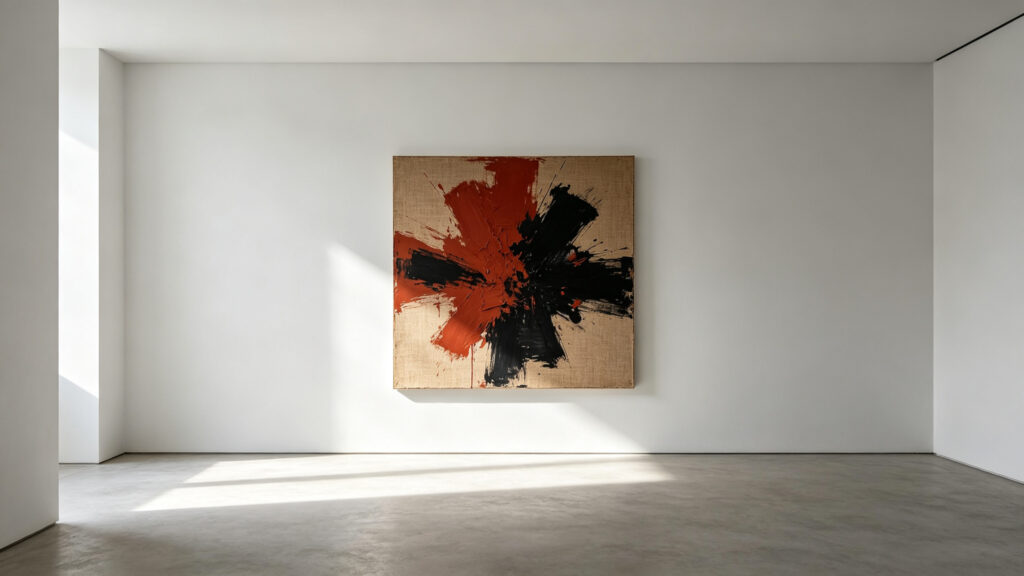
Caption: The most personal choice is often the work that adds meaning rather than simply matching the room.
4. Consider the Space Without Letting the Space Decide Everything
Space is a real participant in any purchase. Wall dimensions, viewing distance, natural light, furniture height, negative space, visual density, framing, scale, and hanging height all shape how a work is actually experienced — at noon, at night, in winter, in a hallway you pass ten times a day. A painting that feels magnificent in a gallery can feel wrong in a room that cannot hold it, and a modest work can feel monumental on the right wall. Knowing how to choose art also means understanding the conditions that allow a work to be seen properly.
So measure, and look with honest eyes. This is an important part of learning how to choose art for a real home rather than an idealized room. Live with the dimensions on paper before you live with the object. But do not let the space make the decision for you. The useful question is not only “Does it match my room?” It is “Does this room allow me to keep seeing and understanding this work over time?” A space can be adjusted — lighting changed, furniture moved, a wall cleared — but a work you do not care for cannot be argued into significance. If you want to think more carefully about placement and proportion, How Can One Painting Transform a Room? A Practical Guide to Displaying Minimalist Art walks through the practical side of display.
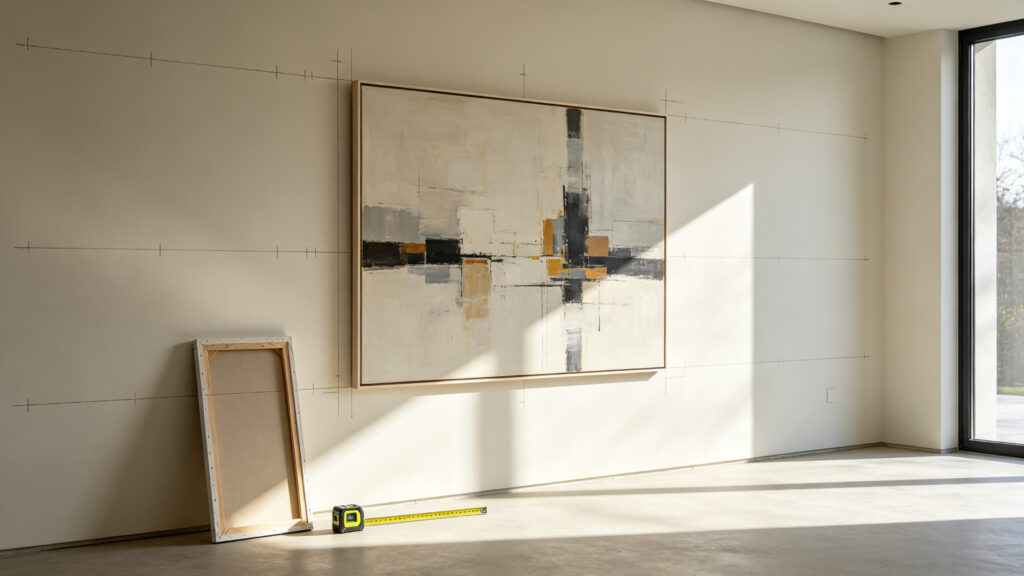
Caption: The right placement gives an artwork the breathing room needed to remain visible over time.
5. Understand the Difference Between Original Art, Editions, and Prints
Much of the confusion around buying art comes from the formats it is sold in, and the terms are used loosely even by people who sell it. Here is a clear, neutral map. Part of learning how to choose art is learning exactly what kind of object you are purchasing.
An original artwork is a one-of-a-kind work by the artist — a painting, drawing, or sculpture that exists as a single object, or in rare cases as a small series the artist defines. It carries singularity: there is only one, and it is yours. A limited edition is a fixed number of identical works, usually numbered — 12/50, for example — and often signed. The edition size is set in advance and will not be enlarged, which gives each example a clear position within a defined group. An open edition is printed without a fixed cap; the image may be produced indefinitely, so there is no number to anchor it. A fine art print is a high-quality reproduction of an image, produced with archival materials and care, and it may belong to either a limited or an open edition.
None of these formats is inherently superior, and none is right for every buyer. An original offers uniqueness. A limited edition offers a place within a defined series at a more accessible level. An open edition or fine art print lets you live with an image you love at a lower commitment. Each may suit a different budget, a different space, and a different collecting goal.
Before you buy, check what you can verify: the medium; the dimensions, both image and framed; the edition size and the number of your example, where applicable; framing status; shipping conditions; condition; certificate information where it exists; and the return policy. Write the answers down. A buyer who understands the object holds a clearer and calmer position than one who relies on feeling alone — though feeling remains the reason you are there at all. Knowing these details makes it easier to choose art with confidence and avoid confusion later.
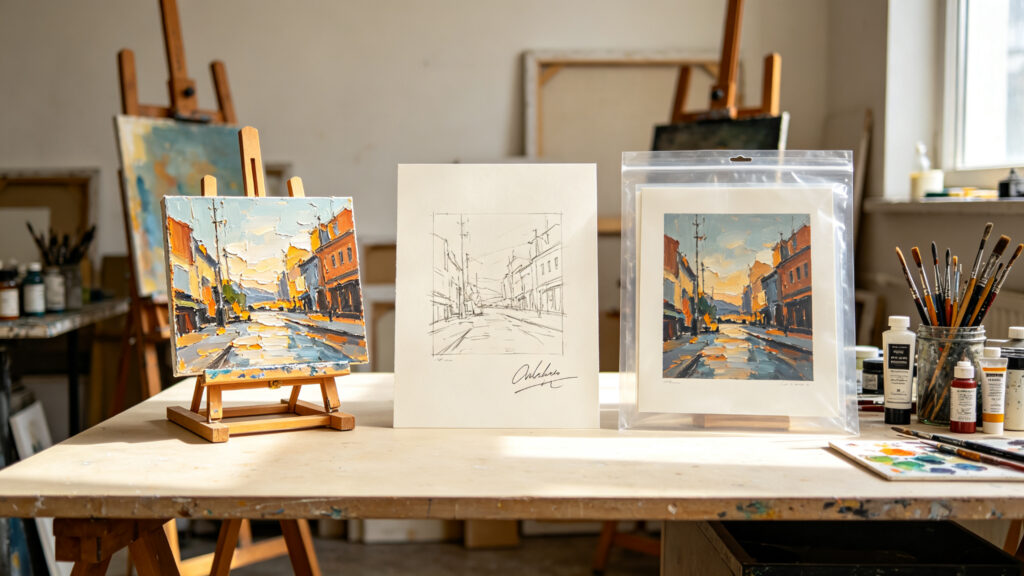
Caption: Understanding the object you are buying makes the collecting decision clearer and more confident.
6. Let Your Budget Create Clarity, Not Pressure
Set your budget before you begin browsing seriously — not after you have already fallen for a work. A thoughtful approach to how to choose art should make the decision clearer, not create financial anxiety. A number chosen freely and in advance is a filter, not a wall: it does not remove pleasure, it concentrates it. When you know your ceiling, you stop comparing yourself to other buyers and start comparing works to each other within a range that is genuinely yours.
Consider the difference between one work you thought about carefully for months and several works bought quickly in a weekend. The first becomes part of your memory; the second tends to blur together. Small originals, works on paper, limited editions, and fine art prints all offer real entry points at different levels, and there is nothing wrong with beginning small. Most serious collections begin with one modest, well-chosen piece.
Urgency is not conviction. If a gallery tells you the work will not wait, that is a sales truth, not a personal one. A work that is right for you will survive a few days of thought; if it genuinely sells, another right work will appear. The fear of missing out is the most expensive emotion in collecting.
For readers weighing the value question from a financial angle, The Investment Value of Minimalist Art offers one perspective — but it should be read as a conversation, not a guarantee. The honest position is this: the financial appreciation of art is never guaranteed. A work’s emotional value, aesthetic value, originality, and long-term companionship are not the same thing as its resale value. Buy the object you want to live with; treat any expectation of profit as an assumption, not a certainty.
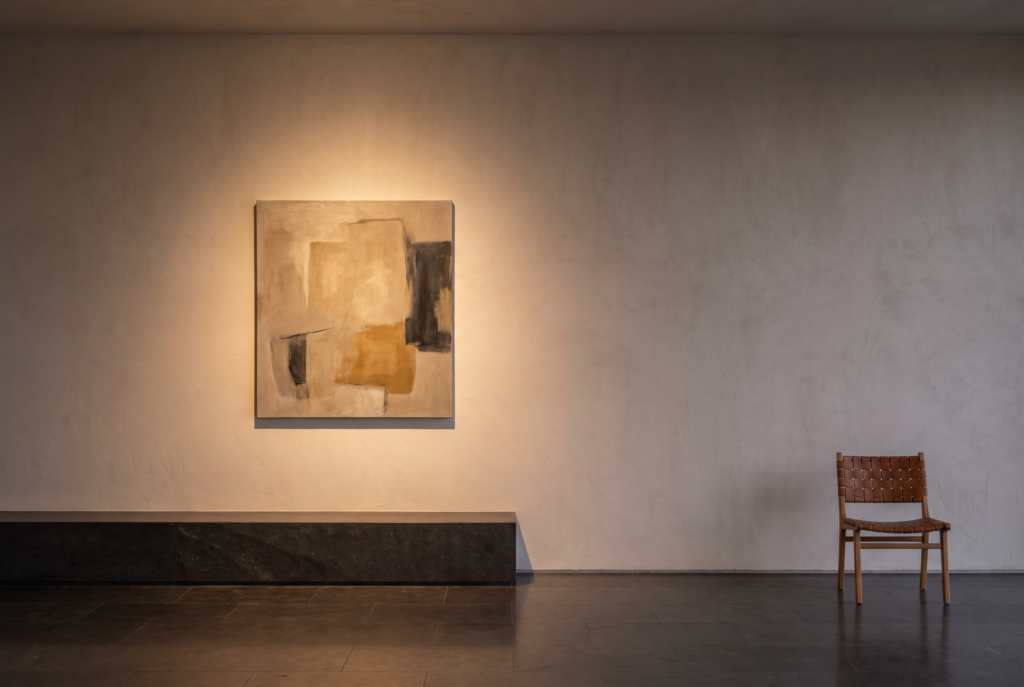
Caption: A clear budget protects the pleasure of collecting from unnecessary pressure.
7. Build a Personal Collection Slowly
A collection is not a count of works; it is the set of relationships between them. The way you learn how to choose art will continue to develop as those relationships become visible. Over years, those relationships become visible. A blue in a print bought last year answers a blue in a painting you found five years ago. Shared moods gather across rooms. One energetic work makes the quiet one beside it quieter, and the quiet one gives the energetic one its edge.
The work of collecting is partly documentation. Record the artist, the title, the medium, the dimensions, the date of purchase — and the reason you were drawn to it in the first place. Years later, that note will be the most valuable thing in the file, because it preserves the person you were when you chose it. Your past reasons are part of the collection.
You do not need to build a collection to impress anyone, or to demonstrate that you are cultured. A collection made to be shown is a display; a collection made from attention is a life. It grows slowly, changes shape, and never finishes. That unfinishedness is not a failure; it is the point.
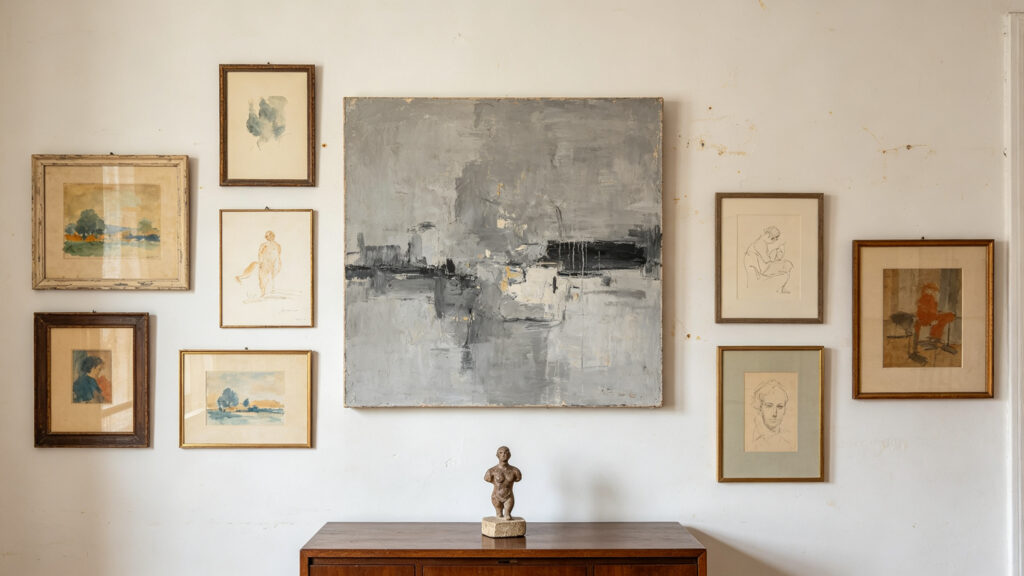
Caption: A collection becomes a portrait of attention as individual works gather meaning over time.
How to Choose Art: A Simple Five-Question Test Before You Buy
Before any purchase, large or small, give yourself the time to consider how to choose art with both feeling and practical judgment, then run through these five questions. Answer them honestly, in your own words, without looking at the price or the label:
- Do I still feel drawn to this work after looking at it more than once?
- Can I explain what interests me without relying only on the seller’s description?
- Does the work have a realistic place in my home or collection?
- Do I understand the medium, dimensions, edition details, price, and delivery conditions?
- Would I still want to live with this artwork if nobody else knew I owned it?
These five questions are not an exam with a pass mark. They are a pause — a way to slow the moment of purchase, to confirm what you already feel, and to bring the details into the light. Most collections are not ruined by bad taste; they are derailed by speed. If most of your answers are honest yeses, you can buy with a clear mind. If they are not, walking away is also a decision, and it costs nothing.
Conclusion: Let Your Collection Become a Portrait of Your Attention
Learning how to choose art is not about pretending to be an expert. It is about learning how to choose art in a way that remains honest after the excitement of the purchase has passed. It is the opposite: permission to watch your own responses more carefully, to trust what you notice, and to take responsibility for the objects you bring into your life. The works you live with will not be judged by visitors who know their market value. They will be judged by you, every morning, in the light of your own rooms.
Begin with one work. Give it time to teach you what you like, and let the collection grow at the speed of real attention. Ask honest questions, keep your notes, and allow your taste to change — it will, and that is a sign of life, not of error. Along the way, you may find yourself thinking about the quieter roles art plays in a home: how it becomes a place to rest attention, a subject explored in Art as an Emotional Sanctuary, or how the way you light a work changes everything about it, a topic covered in Art Lighting for Collectors.
No one can promise you that a particular purchase will be right, and this article makes no such promise. What is guaranteed is only the method: look slowly, choose honestly, and live with what you choose. In time, the collection you build will do more than decorate your rooms. It will become a portrait of your attention, assembled one honest choice at a time.